
It’s June, and that means we get to see a lot of Pride flags. So I figured a few words were in order about the original Pride flag and its immediate descendants.
The Pride flag was born in the mid-1970s, in the first flushes of Gay Liberation. In 1974, San Francisco gay leader Harvey Milk, who was just beginning his career as the ‘Mayor of Castro Street’ and had not yet been elected to public office, challenged Gilbert Baker to create a symbol of gay pride for the gay community (at a time when ‘gay’ was commonly used to include a wide range of queer identities that would now be termed ‘bi’, ‘lesbian’, and ‘trans’ as well as ‘gay’).
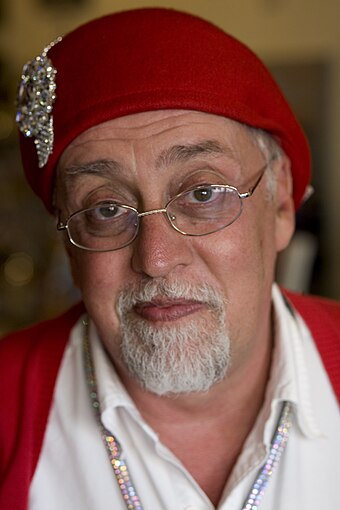
Gilbert Baker
Baker was a political activist, fashion designer, and drag queen who had taught himself to sew after leaving the army in 1972 and then began making banners for the anti-war and gay rights movements. So after Milk and another man had encouraged him to create a symbol, he gradually settled on a rainbow because of its associations with the Hippie movement. Although some have speculated that he was inspired by “Somewhere Over the Rainbow” (Judy Garland having become an icon for Silent Generation and Boomer gays), Baker said that The Rolling Stones song “She’s a Rainbow” was more of an influence.
Working with artist Lynn Sagerblum and a team of 30 sewers, Baker hand-dyed and created two rainbow flags, dying the lengths of cloth in trashcans. That flag premiered in the San Francisco Gay Freedom Day parade on June 25th, 1978 (as SF’s Pride Parade was known at the time). Those flags were long thought lost, but when Baker died in 2017, a section of one of the flags was discovered among his belongings and is now in a museum.
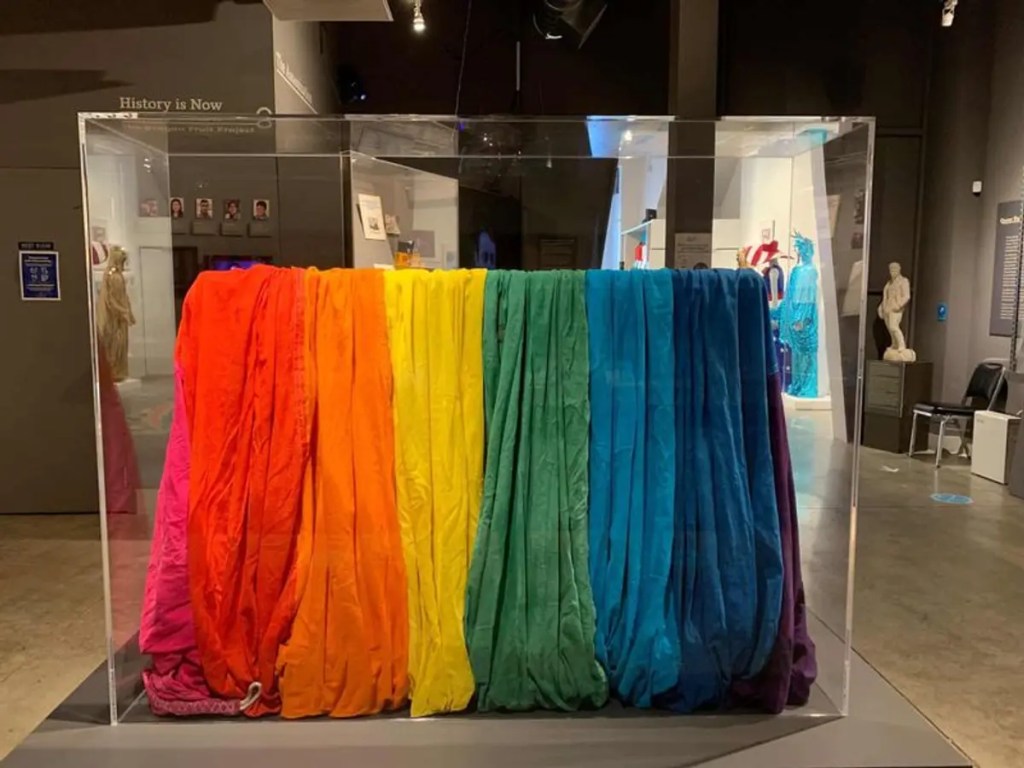
The original 1978 Pride Flag
If you look closely, you can see that the flag has 8 stripes, not the six we are more familiar with. Note the hot pink stripe on the far left and the indigo stripe second to right. Gilbert chose to add the pink stripe because in the 60s and 70s, pink was strongly associated with gay men. (Growing up in the 70s, I strongly internalized the idea that men should never wear pink because “only faggots wear pink”. It’s something I’m still uncomfortable with today.)
Baker also assigned meanings to the colors:
- Pink: Sex/sexuality
- Red: Life
- Orange: Healing
- Yellow: Sunlight
- Green: Nature
- Blue: Magic
- Indigo: Serenity
- Violet: Spirit
The blue stripe was really conceived of as turquoise. The earliest mass-produced flags used a distinctly turquoise fabric (although the 1978 original looks pretty blue to me).
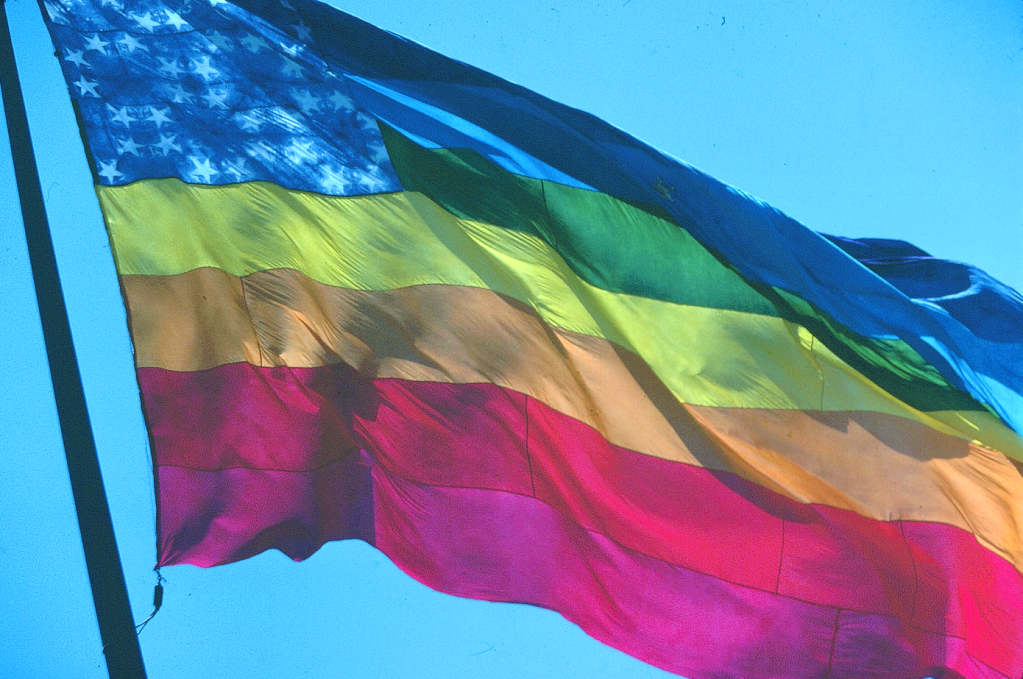
One of the original Pride flags
As you can see here, the original Pride flags were not carried in the parade. Rather they flew on flagpoles at United Nations Plaza, and they were structured to echo the design of the US flag, with a square in the upper left corner filled with stars. The ideology of this flag is clear–the United States is a gay country and should acknowledge its gay citizens. You can see footage from the Parade, including shots of the flags flying, here.
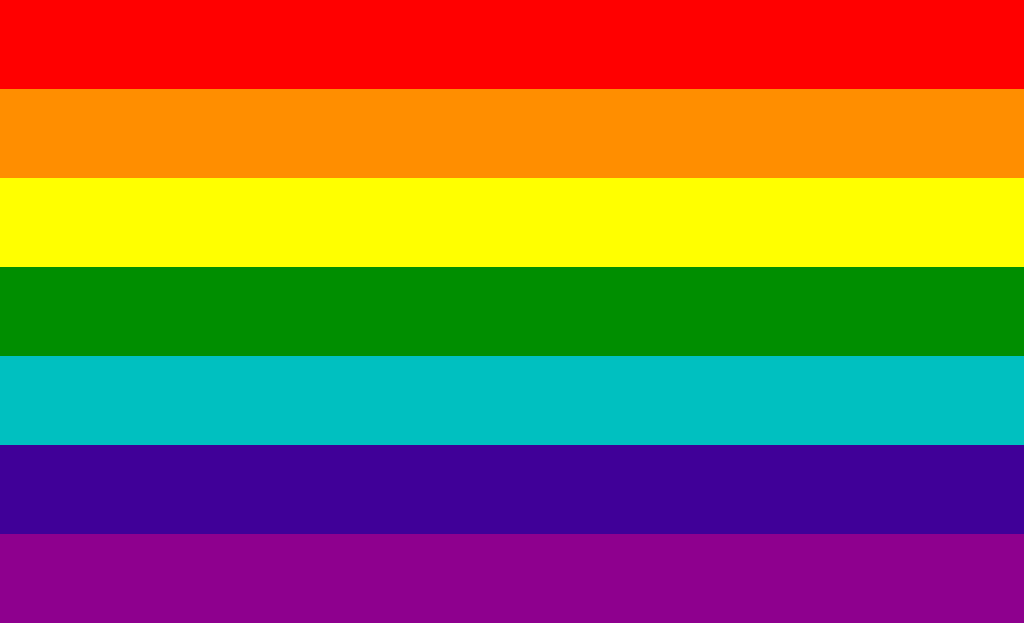
Interest in the flag grew immediately, and exploded a few months later when Milk was assassinated in November of 1978. As a result, the Paramount Flag Company, where Baker worked, decided to mass-market the flag, although they removed the upper left corner and turned the flag into just stripes. At this point, it was discovered that the fabric they had chosen wasn’t available in hot pink and dyeing large batches of fabric was deemed impractical, so the decision was taken to remove the pink stripe and go with a 7-striped rainbow, using turquoise for the blue stripe. So when activists conducted a memorial march for Milk, they used this flag:
The following year, Baker modified the design again. Intending to line streets with hundreds of Pride flags, Baker decided that 6 stripes made more sense, because that way he could split the flag evenly in half, three strips to a side, so that the flags could flank the streets (implicitly making the street a gay space). So Baker chose to merge the turquoise and indigo stripes into the now-familiar 5th blue stripe. This version of the flag went into mass production and grew in popularity within the LGBT community over the 80s and 90s, gradually becoming the symbol of Gay Pride that Milk had intended it to be. Baker called this version of the flag ‘the commercial version’.
Fun fact: Baker became so associated with the Pride Flag that he adopted the drag name ‘Busty Ross’, riffing on the myth that Betsy Ross had sewn the first American flag. As Baker wrote in his biography, “The fabric of freedom is an open weave, with spaces left for us to insert our own versions of the story. This notion must have crossed Betsy Ross’s mind in 1776. The circle of thirteen colonies radiating in her embroidery hoop were a dream of a better world and a new nation, an idea of individual independence and freedom that the Rainbow Flag would disrupt globally centuries later. I wonder if there would even be a Rainbow Flag if it were not for the American flag.”
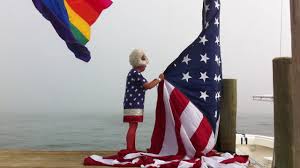
Baker as Busty Ross, raising an American flag on Fire Island
I have more to say about Pride flags, but that’s enough for this post.
 Leather-Bound Press
1 thought on “Pride Flags”