
I just finished a rewatch of Queer as Folk, the ground-breaking drama that ran on Showtime from 2000 to 2005. It made me pretty nostalgic for that period in my life, so I figured I’d discuss it here because it will get me back to posting more regularly. And warning: I’ll be discussing lots of plot points, so if you haven’t seen it and want to be surprised, stop reading and start watching it.

The show was inspired by a British show of the same name, but it had full permission to evolve into its own creature. It focused on a small group of gay and lesbian friends living in Pittsburg. The ensemble was anchored by four close friends all in their late 20s to mid-30s, Brian Kinney (Gale Harold), Michael Novotny (an utterly adorable Hal Sparks), Emmett Honeycutt (Peter Paige) and Ted Schmidt (Scott Lowell). Brian and Michael have been best friends since high school and Michael has been carrying a torch for Brian the whole time. Emmett is the classic nellie gay man, while Ted is uptight, neurotic, and lacks self-confidence.
Around them are Michael’s fiercely protective fag hag single mother Debbie (Sharon Gless) and his gay uncle Vic (Jack Wetherall), who was dying of AIDS until he got access to the first generation of drugs that successfully treated the disease. Brian is the show’s lothario, and in the first episode he hooks up with Justin (Randy Harrison), a 17-year-old high school student, who proceeds to fall deeply in love with him. Brian has a long-running policy of not fucking the same guy twice and never letting any strings get attached, and much of the show’s first season turns on whether Justin can find a way into Brian’s affections. Their complicated relationship becomes a pillar of the whole series. Michael initially gets involved with a status-conscious doctor, but then pairs off with Dr Ben Bruckner (the drop-dead gorgeous Robert Gant), a professor of gay studies who is living with HIV. Emmett and Ted drift in and out of relationships; Emmett’s relationships mostly run into bad luck or poor timing, while Ted repeatedly gets involved with the wrong guys because he’s too desperate. Filling out the ensemble are a pair of lesbians, the Jewish lawyer Mel (Michelle Clunie) and the born-into-privilege artist Lindsay (Thea Gill). Lindsay and Brian are close friends from college and he has agreed to be her sperm donor. In the first episode Lindsay gives birth to a baby, and later in the series, Michael will help Mel have a baby as well.
To understand the show’s importance, it helps to have some context. By the later 90s, television and movies were beginning to show LGBT characters in a more positive light, but almost always as ‘gay best friends’. These characters were usually entirely sexless and mostly for comic relief. Indie queer cinema, however, was exploring LGBT lives in greater depth. Showtime was looking to copy HBO’s success in producing original context, and the network decided to go all-in on QAF in part because its racy nature would help it stand out. The show proved to be a big hit, both with gay audiences and with straight women (who apparently have a thing for attractive, emotionally-available men–who knew?). Many gay bars held weekly viewing parties when they would turn off the dance music and turn the TVs to Showtime, the way some bars do with Drag Race today.

marriage ever shown on US television
The fact that Showtime was a premium channel on cable meant it could be vastly more bold about sex than a regular network show, and QAF leaned into that hard, pun entirely intended. It was the first American show to depict gay sex in a frank way and virtually every episode has at least one sex scene in it. In the pilot, when Brian initiates Justin into sex, there is absolutely no doubt what they are doing to each other in bed, and Brian explicitly talks about rimming Justin. The characters are constantly talking about dicks and hard-ons and various sex acts, especially the enthusiastically foul-mouthed Debbie. Lots of dildos get tossed around. Ted sets up a live porn site in the second season. Mel and Lins get their share of action as well, probably in a bid to attract straight men to the show.
The show depicts the lives of gay men very frankly. The show’s main social space is the decadent gay nightclub Babylon, which has a backroom where Brian and Justin in particular cruise on an almost nightly basis, and Pittsburg is apparently home to multiple bathhouses that Brian and Ted occasionally visit. Recreational drug use is a regular feature of the show, and poppers are frequently referenced. Ted in particular has bad luck with drugs. Ted’s on and off boyfriend Blake (Dean Armstrong) gives him a drug that leaves him in a coma and later on Ted develops a full-blown addiction to crystal meth before eventually getting clean in recovery. The show treats Ted’s addiction with the seriousness it deserves and his slow recovery process is an important plot point in the fourth season.
The show deals with a wide spectrum of issues that the LGBT community was dealing with at the time. There is a running debate through the whole show about whether assimilation to straight society is a good idea or not. Michael craves a stable relationship and social acceptance and he and Ben fully assimilate; they are monogamous, get married in Toronto (where the show was filmed), and eventually move out of Pittsburg’s gay ghetto into a suburb.
Brian, on the other hand, defiantly rejects assimilation. He views gay marriage with open contempt and even when he agrees to be in a relationship with Justin, he insists that it will be an open relationship that either one can walk away from at any time. Even at the end of the show, when he finally admits his love for Justin, they agree that they will not be monogamous. As Brian says early in the series, “I don’t believe in love, I believe in fucking. It’s honest, it’s efficient, you get in and out with a maximum of pleasure and a minimum of bullshit. Love is something that straight people tell themselves they’re in so they can get laid and they end up hurting each other.”

The specter of AIDS hovers over the series as well. At the start of the show, Vic has regained his health, but now has the problem (as many real men in his situation did) that he had run up considerable debts because he had expected to die soon. The fact that Michael and Ben are in a seriodiscordant relationship causes the normally gay-affirming Debbie a lot of trouble and she initially opposes the relationship. The main characters in the show always use condoms during sex, a point Brian makes to Justin in the first episode. In a later season, Ben meets the teenage hustler Hunter (Harris Allen) who is HIV positive; eventually he and Michael agree to foster the homeless boy. Hunter’s poz status causes him problems in high school; his girlfriend’s parents break up their relationship over the issue and eventually his status and past as a sex worker make him an outcast at school.
Anti-gay issues come up quite frequently. In the first season, Justin’s father basically disowns him when he comes out, although his mother Jennifer (Sherry Miller) slowly comes around to fully supporting him and even accepting his relationship with Brian. At the end of the first season, Justin is gay-bashed, and his recovery from his injuries and the way the incident ripples through his life are running issues. A minor supporting character, the drag queen Shanda Leer, is also injured in an anti-gay attack, and the show debates the degree to which gay people can rely on the police to protect them. The central plot of the 3rd season revolves around an anti-gay mayoral candidate, and in the 5th season, Proposition 14 supporters want to ban all legal arrangements that mirror marriage (include domestic partnerships, powers of attorney, and gay adoption); the series ends without a clear resolution to that storyline. Late in the final season, Babylon is bombed, killing 7 people and the bomber is never caught.
The last two seasons are particularly political. President Bush and the White House are repeatedly mentioned, and the Prop 14 storyline is clearly intended to evoke various anti-gay measures being introduced by the GOP. Debbie frequently rails against the unfair way the gay community is treated and decides not to get formally married until her son can do the same. By the end of the series, Mel is openly worried about her family’s safety, and the show occasionally explores how her grandfather’s status as someone who lost his entire family to the Holocaust shapes her sense of what’s happening in the US. Watching the last season, I was struck by how contemporary some of the issues felt to me given the current climate in the US.
The show’s main cast is uniformly solid. Gale Harold and Randy Harrison do an excellent job bringing their complex characters and their unconventional relationships to life in a believable way. Sparks works well with Harold as best friends who will do damn near anything for each other even though they repeatedly fight over issues around assimilation; their push-pull relationship is well thought-out and it’s easy to see why they’ve stayed friends despite their sharply different outlooks on life as gay men.
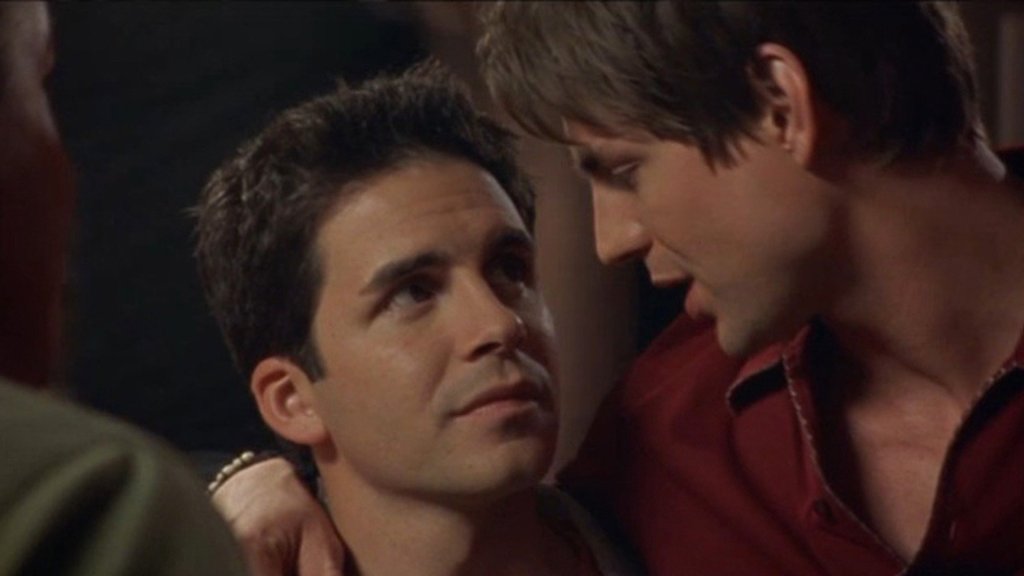
Gale Harold’s Brian Kinney is an incredible character. He is a brilliant advertising executive (although the show’s examples of his brilliant ads usually boil down to “let’s appeal to gay men”), and his brilliance allows him to be a cocky asshole who speaks his mind without sugar-coating it. He’s often an outright asshole, particularly to Michael and Justin. But underneath that we can see how growing up with an abusive father and an obnoxiously devout Catholic mother left him deeply wounded and determined to get by on his own, even when he actually depends on Michael in many ways. He might be a dick to Michael from time to time, but he’s also quite protective of him. He cares deeply, but doesn’t want anyone to know that he cares at all, even though Debbie and Justin see through him. Harold captures all that nuance, often with just a disdainful look.
The only flaw in Harold’s performance is that physically he’s all wrong for the part. Brian Kinney needed to have either stunning beauty or an amazing body, and Harold has neither, which makes the show’s constant statements of how incomparably desirable Brian is quite jarring. In the rather cutthroat world of actual gay hook-ups, Harold would be worse off than Ted Schmidt, who is presented as the least desirable of the core characters sexually.
Nevertheless, Brian Kinney is a truly original gay character, something never shown on American television before or since, a man who is openly, defiantly proud of his gayness, a man who absolutely refuses to bow down to straight society or let it dull his zest for queer life. He is enthusiastically promiscuous; not only does he refuse to apologize for his sleeping around, he is confident that he is superior to most straight people because he’s honest about who he is and what he does. His administrative assistant fully understands that Brian fucks guys in the workplace bathroom and in his office and in one scene she basically tells Ted that’s part of why Brian manages to land customers no one else can get. When everyone else on the show is defeated by various problems, Brian repeatedly finds a solution, often at considerable personal and financial cost. So Brian Kinney perfectly walks the line between being a complete jerk and admirably principled.
Usually, strong gay characters are depicted as people who’ve struggled for years at the margins and found a measure of strength and dignity despite everything that’s beaten them down. But after his shitty childhood, nothing has beaten Brian down. He’s just that strong and determined. By the end of the series, when all the other characters’ lives are changing, he becomes a symbol of the gay community’s will to survive and party in the face of all odds. He remains a deeply relevant character still today.
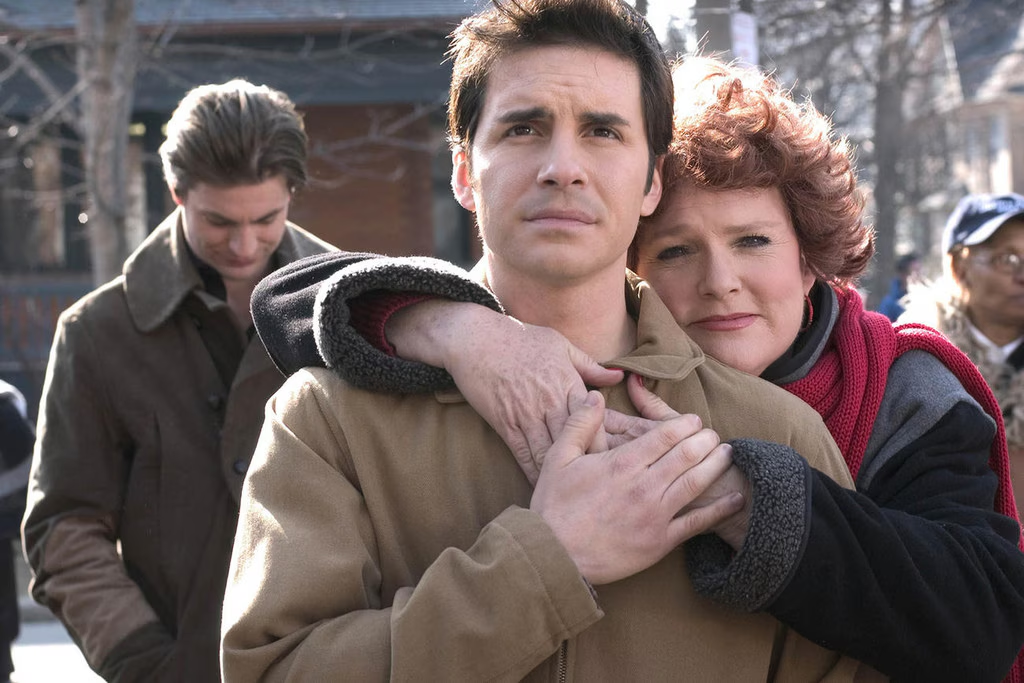
every queer person deserves and not all of us get
The show is not, of course, without its flaws. In true soap opera fashion, the characters often do things that are obviously wrong because they don’t stop for a moment to just think; characters make choices because the show needs dramatic choices more than smart ones. Emmett’s storylines are often highly implausible: he becomes a famous porn star for one season; he dates a wealthy older man who drops dead and leaves him a fortune only to have the man’s relatives get the will invalidated; he dates a closeted star quarterback and eventually persuades the man to come out of the closet (something that still no current major-league football player has done 20 years later); he becomes a famous tv fashion guru (despite his porn star past).
The show’s views are black and white. The main cast are essentially good–the show is 100% on the side of queer people, and anyone who doesn’t fully accept the main characters is villainously bad. Justin’s father actively supports Prop 14 and has Justin arrested for trespassing during a protest. Brian’s mother is a shrill one-note religious zealot. Lindsay’s mother not only doesn’t support her daughter’s desire to get married, she actively thinks Lindsay will grow out of being a lesbian. The supporters of Prop 14 are clearly motivated by nothing more than homophobia. None of these characters gets any redemption or even demonstrates any value to their beliefs.
Ted loses a job basically because he’s gay, and Michael loses a job promotion for the same reason and has to stay in the closet. Apart from Justin’s mother, who slowly comes to fully accept her son’s unconventional lifestyle, and Brian’s 3rd season boss who ignores Brian’s escapades because he brings in too much money, the only character who evolves toward acceptance of homosexuality is a police detective who initially serves as an antagonist to Debbie but gradually evolves into her love interest. Throughout the series, Pittsburg’s gay community is embattled, despite the rather over-the-top nature of its gay nightlife. (Who knew that Pittsburg was a thriving gay metropolis just a little behind NYC, SF, and Chicago in its number of gay and lesbian bars and bathhouses?)
The show’s lack of any trans character is a major omission. There is one very minor character in the last season who is referred to as a ‘tranny’, but it’s unclear if she’s trans or a drag queen, and the character is mostly played for a laugh in the one or two scenes she’s in. While drag queens are frequently background characters, particularly when Babylon hosts an event, only two drag queen characters get any attention, although Emmett’s first roommate in Pittsburg was the drag queen Godiva who dies of AIDS off-stage and is referenced several times. One first season episode features a leatherman who introduces Ted to BDSM, but Ted’s supposed interest in leather is only referenced in one other episode (when he shows up to a party in leather in a scene where all the gay characters are actively trying to shock straight party-goers).
Mel and Lins’ plot-lines are not unreasonable, but mostly revolve around getting married, having babies, and being tempted to be unfaithful; it sort of reads as a group of male screenwriters who can’t imagine what else lesbians do that might be interesting to watch. Virtually all the lesbians are rather femme; although a few scenes have butch lesbians in the background, none gets a speaking role, and Mel’s biker ex-girlfriend is the epitome of the Hollywood ‘tough but sexy’ dyke that straight guys will fantasize about.
The show is also resolutely white. Brian occasionally fucks a Black guy here or there, usually in montage, but I can think of only two Black characters who gets any dialog; one is a married suburban gay in the last season, and the other is an actor on the show’s in-show satire of itself Gay as Blazes, a gay soap opera that is excruciating politically correct (and which gets canceled in the 3rd season). The only Asian character that appears in more than one episode is a joke–a Japanese hustler who speaks no English whom Emmett is convinced is following him around because they’re in love when in reality all the character wants is to get paid. So the show had some real blinders around racial issues.
The show’s cast demonstrates how groundbreaking it was. Only two known actors were cast, Sharon Gless, best known as half of the female-cop duo Cagney and Lacy, and Hal Sparks, a comedian who was best known as the host of Talk Soup, a cable show that made fun of other cable shows. All the others were basically unknowns, some of whom were getting their first major tv roles precisely because the producers couldn’t find established actors willing to play gay characters. The producers had a lot of trouble getting talent agents to refer actors for auditions because there was such a stigma against playing gay characters, since there was a strong sense that doing so would destroy an actor’s career. In fact, the character of Brian Kinney was only cast the day before production started because they were having trouble finding actors willing to even audition for a gay role. Several of the straight actors had to adopt a policy of not discussing their real-life sexual orientation in interviews because they felt it was a homophobic question.
The main cast is uniformly solid in their acting, and Harold, Harrison, Paige, Lowell, and Sparks all stand out in one way or another for the depth of their acting. But despite QAF being a reasonably high-profile show that got a lot of media attention and a very strong fan base, it’s notable that no one in the cast went on to a really solid career, although Harold did get an important recurring role on Desperate Housewives, Sparks has gotten some work as a voice actor, and Gant has had a recurring role on Supergirl. It’s hard to avoid the conclusion that these actors paid a career price for having the guts to play queer characters.
The show also does something almost unheard of in either tv or film. It shows us a basically healthy, functional non-monogamous relationship and allows Brian to aggressively advocate for ethical non-monogamy. Brian and Justin set explicitly-stated rules and stick to them. While Justin initially wants a traditional monogamous romantic relationship, he agrees to accept an open relationship and by the end of the series it’s clear that he see the value in it and fully accepts that his relationship with Brian won’t work if they embrace monogamy.
It’s extremely rare for tv or film to show open relationships, and when they do, it’s nearly always non-ethical non-monogamy–one character dislikes it but feels unable to insist on monogamy. The partner who wants the open relationship is usually shown as doing so to the detriment of the other partner and is in some sense the villain of the relationship. And not only does QAF give us a stable, functional open relationship in which both characters are good guys, the show dares to let there be a clear and fair debate about the issue in which both sides have good arguments to make.
One of the major challenges of non-traditional relationships (open marriages, polyamory, master/slave relationships and the like) is that we have very few role models for these dynamics. It’s hard to develop healthy models for alternative relationships for the simple reason that we don’t get to see what they’re supposed to look like. QAF offers a chance to see what one couple’s arrangement looks like and some of the challenges they encounter and overcome.

If you’re a younger LGBT person, this show offers an really good look into many of the issues the LGBT community was facing at the turn of the millennium, and while it exaggerates how rough life was for us back then, the portrait it paints is a reasonable one. This was an era before gay marriage was legal; in fact gay sex was still a crime in many states when the show premiered. Few high schools had things like Gay-Straight Alliances. Most gay people tended to be in the closet at least at work and church, and Don’t Ask Don’t Tell was the official policy of the US military. Most Americans were still opposed to extending any sort of legal or social approval to LGBT people’s lives. AIDS was no longer an automatic death sentence, but it was still the leading cause of death of gay man and would remain so for years after the show ended.
So if you’ve never seen it, give it a watch. Be prepared for some rather silly plot lines and some serious blind spots, but also for what is probably the most realistic depiction of a gay community and its joys and struggles that American television has ever offered us.
 Leather-Bound Press